A desk flag has one job the outdoor version never faces: it has to read clearly from three feet away, on a surface where a phone, a nameplate, and a coffee cup are already competing for attention. Get the size and the base wrong and it either disappears behind a monitor or tips over every time someone bumps the table. Most of the decisions that matter are made before a single color is chosen, and they come down to four things: format, base, fabric, and how the two faces are printed.
Desk flag or table flag: the distinction that changes the order
The terms get used interchangeably, but the hardware is different. A desk flag is the small format meant to sit on an individual’s workspace or a reception counter, typically a 4 by 6 inch flag on a short pole of roughly 10 to 12 inches, or a satin 6 by 4 inch flag on a 30-something centimeter chrome staff. A table flag is the larger executive format built to be seen across a conference table or lectern, commonly in the range of 12 by 8 inches (about 30 by 20 centimeters) on a 44 centimeter pole. If you are buying for a boardroom, the 4 by 6 will look lost; if you are buying twenty for individual desks, the executive size is overkill and eats storage. Decide which surface the flag lives on before you decide anything else.
The sizes that actually sit on a desk
Six formats cover almost every indoor request. At the economy end sits the vellum paper card, around 6 by 3 inches on a gold pin, useful for single-event place settings where the flag is effectively disposable. The workhorse is the 4 by 6 inch stock desk flag on a weighted base, the size you see in conference rooms and diplomatic settings. Satin deluxe flags at 6 by 4 inches add sheen for a more formal look. A common custom-print format is roughly 9.8 by 5.9 inches on a telescopic pole. Above that, the 8 by 12 inch parade-mount and the 12 by 18 inch large miniature start to blur into hand-held territory, and are usually mounted on an 18 to 24 inch stick rather than a base. The jump in presence is not linear with the label on the box, which is worth seeing in terms of actual printed area.
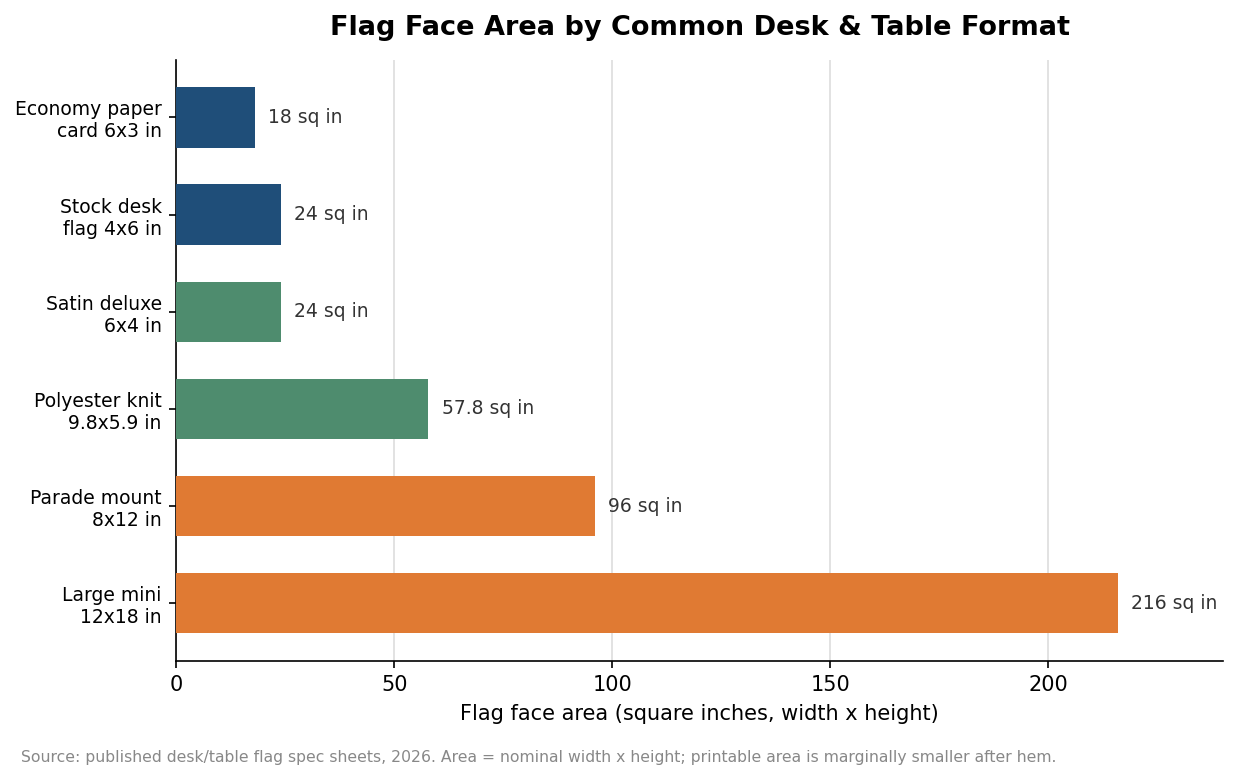
The point the area comparison makes is that a 12 by 18 inch flag carries roughly nine times the face area of a 4 by 6, so a logo that is legible on the large format can become an unreadable smudge when the same artwork is dropped onto a desk flag without being simplified. If your brand mark has fine text or a tagline, plan to thicken strokes and drop the smallest type for anything at or below the 6 by 4 inch size.
Bases and poles: where stability is won or lost
The base is the part buyers underweight and then regret. A 2 inch wooden base with a cork center is cheap and can hold up to five vellum flags at once, which suits a multi-flag centerpiece but offers little mass against a knock. Small chromed bases typically accept one, two, or three poles and give a cleaner desk look. For anything that needs to stay upright on a shared table, a weighted metal base earns its cost: a large chrome base around 9 centimeters in diameter with a telescopic pole extending from roughly 23 to 42 centimeters gives both stability and height adjustment. Plastic bases are fine for giveaways and short-term display, but for a permanent office fixture near a walkway, specify weighted metal and save yourself the daily righting of a toppled flag.
Pole diameter tracks flag size for a reason. A 4 millimeter staff suits the small satin flags, while the executive format wants a 6 millimeter pole so the flag does not droop or whip when the base is moved. If you are ordering a mixed set for a head table, match the pole heights deliberately rather than accepting whatever ships as default, because a row of flags at inconsistent heights reads as sloppy from across the room.
Fabric and sheen: matching material to the room
Indoor flags are chosen for how they catch light, not how they survive weather. A knitted polyester around 3.25 ounces per square yard is durable and takes dye-sublimation color well, which is why it shows up on custom desk flags meant to last. Satin polyester, roughly 195 to 200 grams per square meter, trades some ruggedness for a soft sheen that photographs well under office lighting and suits formal or ceremonial settings. Vellum paper is the economy option for single-use place cards where longevity is irrelevant. One practical caveat worth stating plainly: cheaper stock flags positioned near a sunny window can visibly fade within weeks, so if the flag sits in direct light, pay for the better fabric and sublimation printing rather than a bargain screen print.
Single-reverse or double-sided, and what it costs
This choice sets both the look and roughly half the price. A single-reverse flag prints the design on one ply of fabric and lets it bleed through to the back, where it appears mirrored. That is perfectly acceptable for a symmetrical emblem or a flag seen mainly from one side, and it is the more economical build. A true double-sided flag sews two printed plies together with an opaque blockout liner between them, so both faces read correctly and no light shines through. For a flag that sits on a desk against a window, or one that will be viewed from both sides at a reception counter, the double-sided construction is worth the premium; for a desk flag against a wall, single-reverse usually does the job. Where the two builds land on price depends heavily on quantity, fabric, and base, and the bands below are indicative rather than quotes.
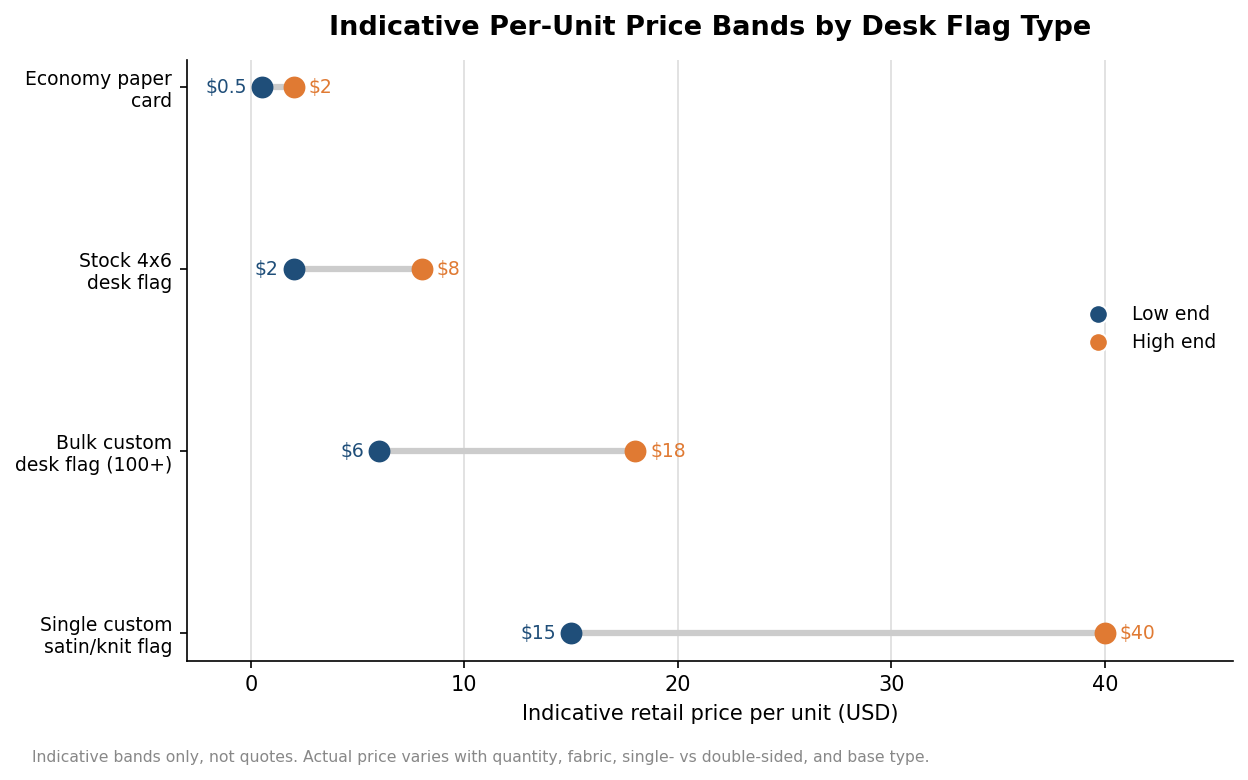
Read the price bands as ranges that move with your order, not fixed figures. A stock 4 by 6 desk flag bought off the shelf and a custom-printed satin flag ordered as a single unit are different products at different price points, and the per-unit cost of a custom flag drops substantially once you are ordering in the hundreds. If budget is the constraint, the biggest lever is usually quantity, followed by choosing single-reverse over double-sided and a plastic base over weighted metal. If presentation is the constraint, spend on the fabric and the base first, because those are what a visitor actually notices.
Put the four decisions in order and the rest of the specification falls into place: pick the format for the surface, the base for the stability you need, the fabric for the room’s lighting, and the print construction for how the flag will be viewed. Nail those and the artwork step becomes the easy part.