A custom toothpick flag is one of the smallest print jobs a kitchen will ever order and one of the most visible. It sits on top of the plate, at eye level, next to the food a guest is about to eat. Getting it right is less about design flair than about five specific decisions: the flag size, the pick length, the material that touches the food, the artwork, and the quantity. Work through them in that order and the order goes smoothly. Skip one and you end up with flags that tip over, picks too short to hold a club sandwich, or a run of five thousand that misses your event by a week.
Start with the flag, because it sets the scale
Most custom toothpick flags print at roughly 1 inch by 1.5 inches, and a few shops run 1.5 by 1. That size is deliberate: the flag has to read from a standing guest’s eye line without dwarfing a canape. At an inch wide you have room for a logo, a short product name, or a two- or three-word label such as “gluten free” or “medium rare,” but not for a paragraph. Treat the flag as a sign, not a card. If your design carries fine serifs, thin rules, or text below about 8 points at final size, it will fill in or disappear once it is printed that small. The most common fix is the simplest one: enlarge the mark and cut the words.
Match the pick length to the dish, not the other way around
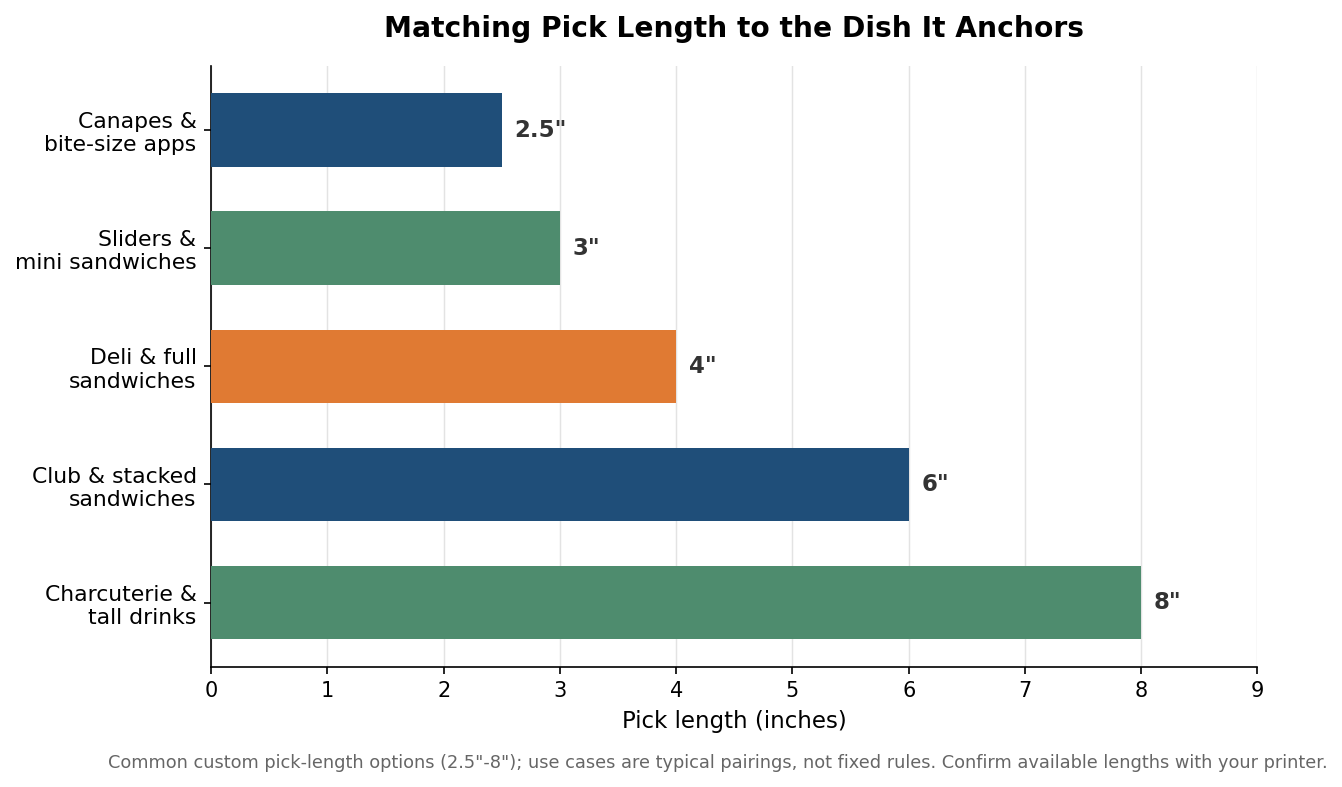
This is the decision buyers most often get wrong, because the default 2.5-inch toothpick looks fine in a sample photo and then vanishes into a stacked sandwich. Pick length is what actually holds the food together and keeps the flag upright, so choose it from the tallest item it has to pierce. A 2.5-inch pick suits canapes, olives, and bite-size hors d’oeuvres. Step up to 3 inches for sliders and mini sandwiches, 4 inches for deli and full sandwiches, and 6 inches for club and stacked builds where a short pick lets the top layer slide off. The longest common option, 8 inches, is really a cocktail pick meant for charcuterie boards, tall drinks, and layered desserts. When you are unsure, size up an inch. A slightly long pick reads as deliberate; a short one reads as a mistake.
Know what actually touches the food
The part of a flag pick that enters the food is the wood, not the paper flag, and that is where food safety actually lives. Reputable picks are made from untreated hardwood, usually birch or bamboo, with no dyes, varnish, or coating on the shaft. Ask your supplier to confirm the pick is food-contact grade and free of surface treatment. That is a fair question, and any serious printer will answer it plainly. The printed flag itself normally sits above the food and does not make contact, but the inks still matter, so look for food-safe inks rather than assuming them. Be a little wary of “FDA approved” used as a slogan. The FDA does not approve a finished toothpick flag as a product; it regulates the materials and inks that go into food-contact articles. A precise answer about the wood species and the ink is worth more than a badge on a listing.
Design for a one-inch canvas
Custom flags print full color on both sides at almost every shop, usually on a digital press, and many will match a specific brand color to a Pantone reference rather than leaving it to a four-color build. Hand over vector artwork if you have it, keep a small bleed so color runs to the folded edge, and remember that both faces show, so decide up front whether the back repeats the front or carries a second message. Because the flag folds over the pick, the usable height per side is a little under the flat dimension, so design inside the supplier’s template and safe area rather than to the trim. If your logo is a light color on white, add a thin keyline or a colored field behind it so it does not float and vanish on the paper.
Buy for the quantity that fits your calendar and your budget
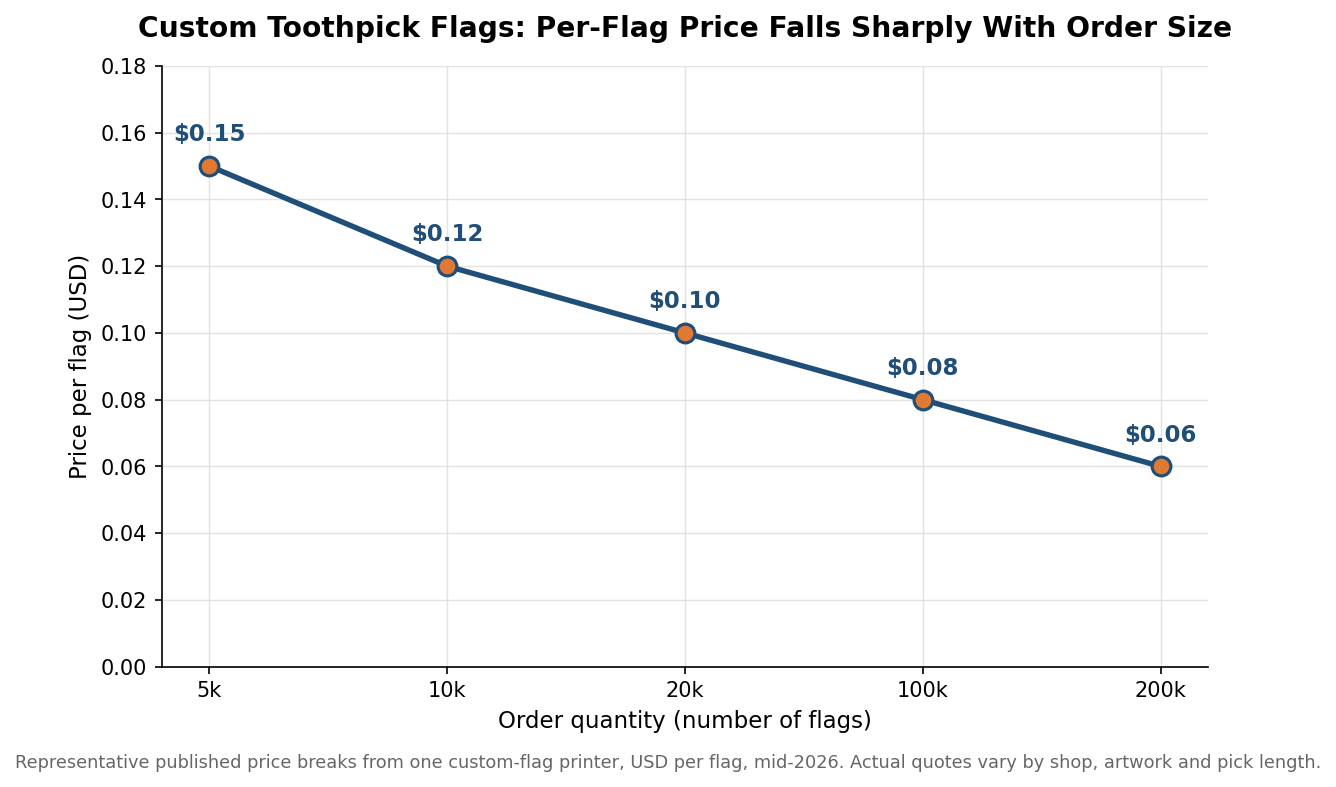
Minimums vary more than any other spec here. Small-run digital shops will print as few as 50 to 100 flags for a single event, while volume printers set floors at 1,000 to 5,000. Per-flag cost then follows the usual curve. One national supplier publishes breaks that run from about 15 cents each at 5,000 flags down to 6 cents at 200,000, with an entry tier near 1,000 pieces often landing in the low hundreds of dollars in total. Those numbers are indicative rather than a quote for your job, since pick length, color count, and rush status all move them, but the shape holds nearly everywhere: the price per flag drops fast up to roughly 20,000 and then flattens out.
Lead time is the other half of the calendar. Standard production tends to run three to four weeks from art approval, with orders above 5,000 flags sitting at the longer end, and many shops offer rush service in the range of three to fifteen business days for a fee. Build in time for a physical proof if the color has to match a brand exactly, because a screen preview will not tell you how a particular ink sits on coated paper. Order a little over your headcount as well. Flags are inexpensive, they get knocked off plates and pocketed by kids, and a caterer who runs out in the middle of service has no way to reprint one on the spot.
Put it together
Specify in this order and the rest falls into place: a 1-by-1.5-inch flag, a pick length chosen from the tallest dish it has to hold, an untreated birch or bamboo shaft with food-safe ink, artwork built inside the template for a one-inch canvas, and a quantity that clears both your event date and your price target. A toothpick flag is a small thing, but it is the last object standing between your brand and the guest’s hand, and it is worth specifying like you mean it.